Inflation is back at four per cent
Annual inflation in Spain was 4.3% in August 2026. That is seven tenths above July and the highest reading since February 2023. In a single month prices rose 0.7%.
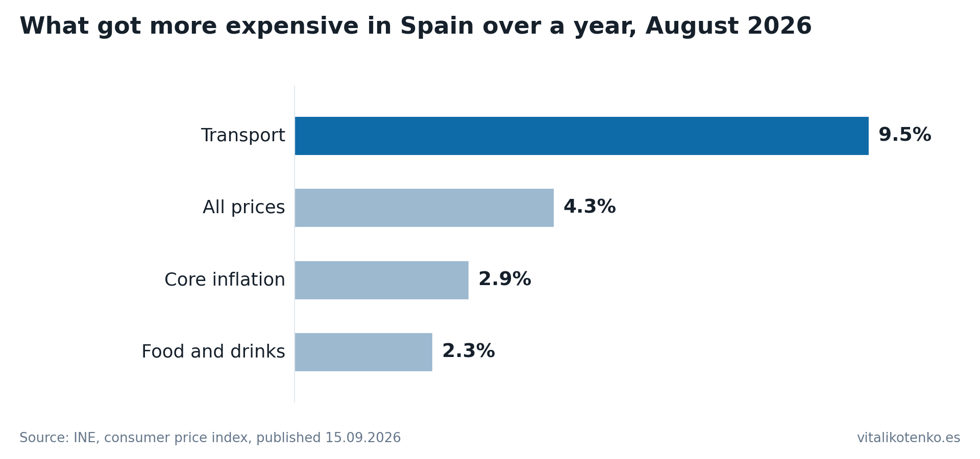
The second number matters more. Core inflation, which leaves out fresh food and energy, stayed at 2.9%. A gap of 1.4 points says something simple: what is rising above all is energy and whatever depends on it. Transport went up 9.5% over the year, food and non-alcoholic drinks only 2.3%.
The practical conclusion: the rise is not in the supermarket basket but in the bills and on the road. Someone who drives to the next town every day will feel this year more than someone who lives within walking distance of the sea, the school and the shop. It is an argument for a home inside the town rather than in a remote urbanisation with a nice view and two cars that every family needs.
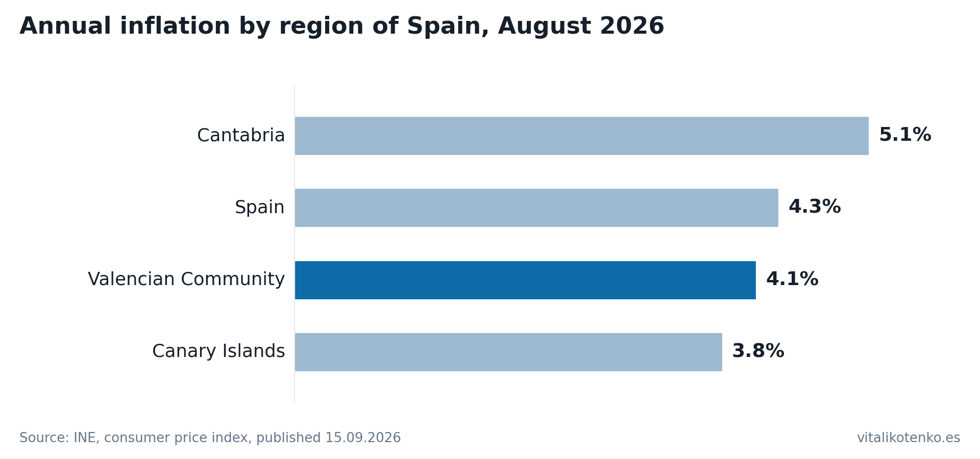
Our stretch of coast is getting pricier more slowly than the Spanish average
By autonomous community, August ranged from 3.8% in the Canary Islands to 5.1% in Cantabria. The Valencian Community, which covers Benidorm, Finestrat and our whole stretch of coast, came in at 4.1%.
This fits the spending data: according to the household budget survey for 2025, spending per person in the Valencian Community was 13,704 euros a year against a national average of 14,066 euros. The difference is measured in per cent, not in multiples, but the direction is steady.
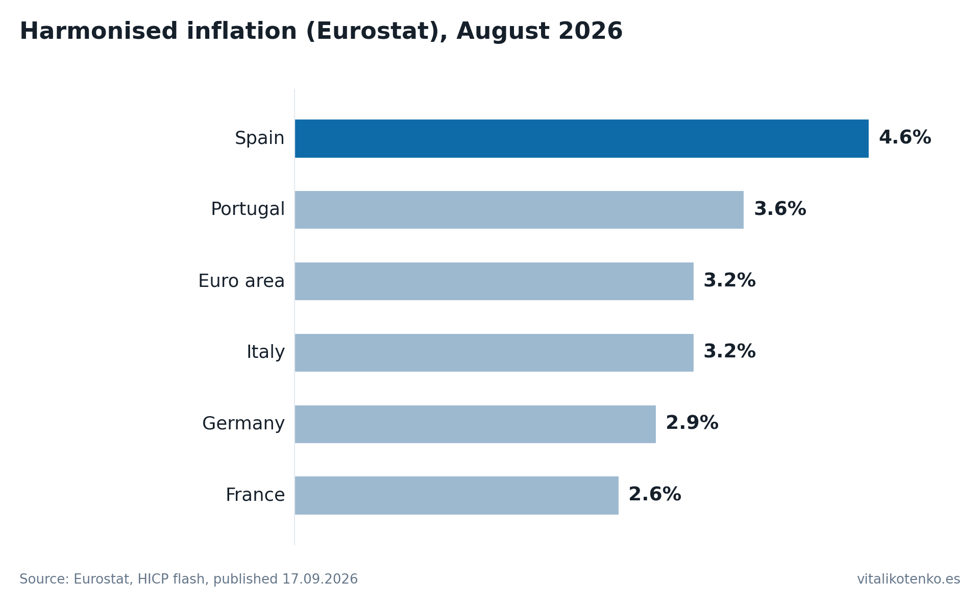
Spain against its eurozone neighbours
Eurostat measures inflation with a single method, so countries can be compared with each other. August 2026 looks like this: Spain 4.6%, the eurozone as a whole 3.2%, the European Union 3.2%. Germany 2.9%, France 2.6%, Italy 3.2%, Portugal 3.6%.
The gap with France is two points, and with Germany almost the same.
The familiar picture of southern Europe getting cheaper relative to the north does not hold this year. For a buyer it means that a cost estimate built on someone else's experience from two years ago is too low today.
What the official autumn 2026 figures show
| Indicator | Value | Reference date | Published by |
|---|---|---|---|
| Annual inflation in Spain | 4.3% | August 2026 | INE, 15.09.2026 |
| Core inflation | 2.9% | August 2026 | INE, 15.09.2026 |
| Annual inflation in the Valencian Community | 4.1% | August 2026 | INE, 15.09.2026 |
| Transport over the year | plus 9.5% | August 2026 | INE, 15.09.2026 |
| Food and non-alcoholic drinks over the year | plus 2.3% | August 2026 | INE, 15.09.2026 |
| Harmonised inflation in Spain | 4.6% | August 2026 | Eurostat, 17.09.2026 |
| Harmonised inflation in the eurozone | 3.2% | August 2026 | Eurostat, 17.09.2026 |
| Annual spending per household | 35,101 euros | 2025 | INE, 25.06.2026 |
| Spending per person in the Valencian Community | 13,704 euros | 2025 | INE, 25.06.2026 |
| Minimum wage | 1,221 euros a month, 14 payments | from 01.01.2026 | BOE, 19.02.2026 |
| Average pension of the system | 1,373.44 euros a month | August 2026 | Ministry of Inclusion, 24.08.2026 |
| Average retirement pension | 1,574.9 euros a month | August 2026 | Ministry of Inclusion, 24.08.2026 |
Amounts as published by each source, not recalculated.
Where a Spanish family's money goes
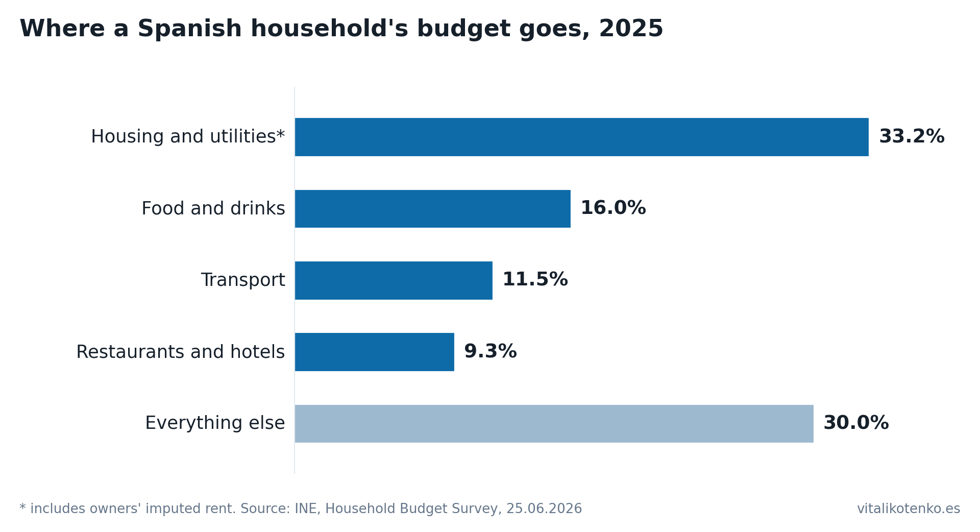
The average household spent 35,101 euros in 2025, 3.1% more than a year earlier. This is how the spending splits:
| What on | Share of the budget |
|---|---|
| Housing, water, electricity and gas | 33.2% |
| Food and non-alcoholic drinks | 16.0% |
| Transport | 11.5% |
| Restaurants and accommodation away from home | 9.3% |
Household Budget Survey 2025, INE, 25.06.2026.
Hear about launches first
On Telegram I write about new phases and sales launches before they reach the site, plus my reviews from building sites.
Subscribe on TelegramA third of the budget on housing looks alarming, and a caveat is needed here. In this group INE counts not only bills and rent but also imputed rent: the estimated amount a family would pay for its own home if it were a tenant. For an owner this is not real money leaving the wallet, so the 33.2% describes the cost of living in a home, not the size of the payments.
An owner's real money goes on utility bills, the community of owners fee, the IBI property tax and insurance. A non-resident buyer also has the annual Modelo 210 return, even if the flat stands empty and is not let.
What incomes this sits on
The minimum wage for 2026 is set at 1,221 euros a month in 14 payments, that is 17,094 euros a year. It rose 3.1% from 1,184 euros in 2025.
The average pension of the social security system in August was 1,373.44 euros a month, 4.6% more than a year earlier. The retirement pension is higher: 1,574.9 euros.
Put that next to inflation of 4.3% and it becomes clear why the cost of living never leaves the front pages of Spanish newspapers. This year the minimum wage fell behind inflation, and pensions barely got ahead of it.
The INE living conditions survey adds one more detail: 8.5% of the population make ends meet with great difficulty, and 36.4% could not cover a large unexpected expense.
How to read these figures
What it means for a buyer
First. When you work out the budget for living here, take current figures, not stories from friends about how cheap everything was in 2021.
Second. Transport and energy are rising fastest, not food. That bears directly on where you live: a flat in town and a house on a hillside urbanisation differ in monthly costs more than it seems at a viewing.
Third. An owner's costs are predictable and can be worked out in advance. They are not a sum that suddenly doubles, unlike rent, which on the coast is reviewed every year.
Fourth, and it is often missed. Inflation at 4.3% with a mortgage rate below that works in the borrower's favour: the debt loses value faster than it is paid off. It is no reason to borrow for the sake of borrowing, but it is a reason to run the numbers with financing instead of ruling it out straight away.

I, Vitalii Kotenko, counted and checked the figures. I live in Finestrat and work with new builds on the coast from Villajoyosa to Altea. I update this piece once a month, when INE publishes fresh data.
 Vitalii Kotenko, new-build agent on the Costa Blanca, RE/MAX Benidorm. I recount the figures on Mondays, and the update date changes together with them.
Selections on this topic
- Five cheapest ways into the marketThese are the five cheapest new homes to live in that are available today between Alicante and Dénia.
- Four projects within walking distance of the beachDistance to the sea is the one thing you cannot change later.
- Keys now, not in three yearsMost new builds in the area are handed over in 2027 and 2028.
More analysis
- Villajoyosa: a town by the sea that lives its own lifeSix blue-flag beaches, its own hospital and the most affordable typical metre on the coast. New builds in Villajoyosa from 240,000 €.
- Almost €2 billion in four years: how many homes Ukrainians bought in Spain and where they buy most14,399 home purchases by Ukrainians in Spain in 2022-2025, about €1.8-1.9bn. 38% in Alicante province. Notary data by year, province and town.
- You are better off with me than without meThe question I get most often in private messages is this: if I walk into the sales office on my own, without an agent, will they give me a better price? My answer is no.
Where the numbers come from
INE, Consumer Price Index, August 2026. Published 15 September 2026. ine.es/dyngs/Prensa/IPC0826.htm
Eurostat, harmonised inflation in the euro area and the EU, August 2026. Published 17 September 2026. ec.europa.eu/eurostat/web/products-euro-indicators/w/2-17092026-ap
INE, Household Budget Survey 2025. Published 25 June 2026. ine.es/dyngs/Prensa/EPF2025.htm
INE, Living Conditions Survey 2025. Published 5 February 2026. ine.es/dyngs/Prensa/ECV2025.htm
Ministry of Inclusion, Social Security and Migration, average pension for August 2026. Published 24 August 2026. inclusion.gob.es
BOE, royal decree on the 2026 minimum wage, BOE-A-2026-3815. Published 19 February 2026. boe.es